Ti-6Al-7Nb
Selected over Ti-6Al-4V to address the report’s concern about possible vanadium release, while retaining the strength and stiffness needed for the piston rod.
CAD / SOLIDWORKS · FINAL-YEAR TEAM PROJECT
I designed a piston-driven extrusion head concept for biomanufacturing in space. This page follows the key decisions: why extrusion, how the mechanism works, how the assembly was modelled, and why its materials were selected.
01 / WHY
The report screened inkjet, laser-assisted and extrusion printing against the project’s space-use criteria. Extrusion offered the best overall balance for this concept: a broad bio-ink range, scalability and cited spaceflight heritage, with moderate resolution as the trade-off.
| Criterion | Inkjet | Laser | Extrusion · selected |
|---|---|---|---|
| Bio-ink viscosity | Low | Medium | Low to high |
| Resolution | High | Very high | Moderate |
| Cell viability | Moderate (heating noted in report) | High | Moderate to high |
| Cost & complexity | Low | Very high | Low to moderate |
| Print speed | Fast | Slow | Moderate |
| Scalability | Poor | Poor to moderate | Good potential for larger structures |
| Space readiness | Low (droplet placement relies on gravity) | Moderate (equipment described as fragile) | High (report cites Redwire’s BioFabrication Facility) |
Design decision: extrusion was selected as the practical trade-off. It supports a broad viscosity range and larger constructs; its resolution is moderate, so it was not the strongest option on every criterion.
02 / WHAT
The chosen technique is extrusion. Within it, the project uses a piston-driven mechanism: a lead screw advances the piston, displacing bio-ink from the reservoir through the nozzle and onto a substrate.
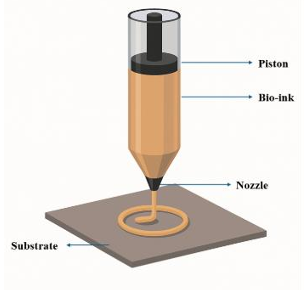
The piston gives direct positive displacement control over flow and volume, with less sensitivity to pressure fluctuations than pneumatic delivery. The report preferred it over screw-driven extrusion, which adds mechanical complexity and mass.
Two different uses of “screw”Here, the lead screw moves the piston. In screw-driven extrusion, the screw itself conveys the bio-ink. The report selected piston-driven extrusion, actuated by a lead screw.
03 / HOW
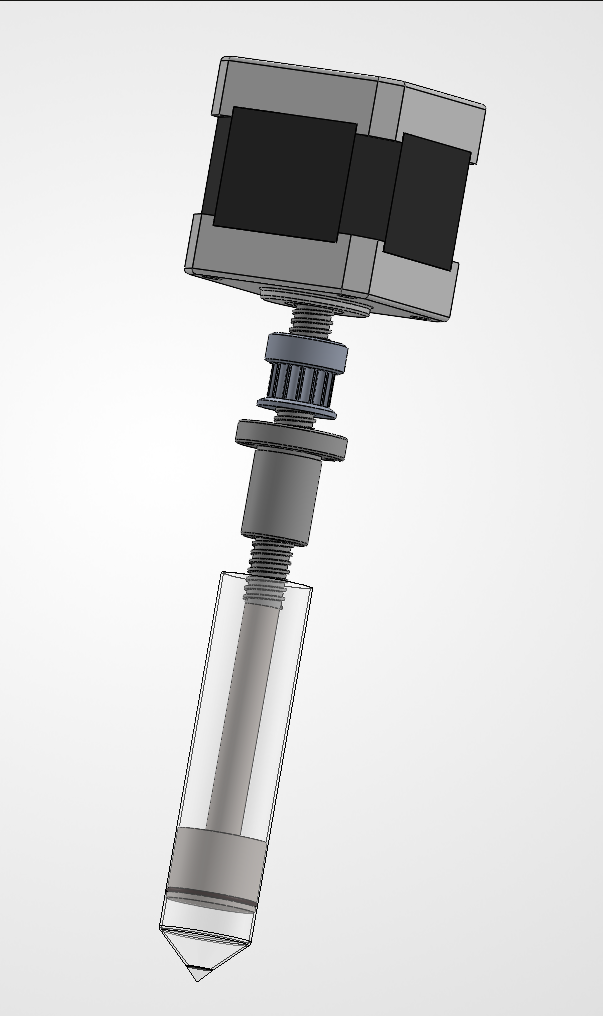
My SolidWorks work focused on the extrusion components and their assembly interfaces. The actuator model was imported as reference geometry; the assembly shows how the piston, reservoir and nozzle work together as a head.
04 / WHY THESE MATERIALS
Ansys Granta EduPack was used to screen materials against each component’s role, prioritising biocompatibility and the relevant mechanical and operational requirements.
Selected over Ti-6Al-4V to address the report’s concern about possible vanadium release, while retaining the strength and stiffness needed for the piston rod.
Chosen to balance toughness with transparency, so the reservoir can withstand handling while allowing ink-level visibility.
Selected for a single-use nozzle: its chemical resistance, cost and manufacturability support simple replacement and sterility assurance.
Scope / next steps: the assembly is a concept and omits supporting structures such as a frame, bearings and guides. The report leaves nozzle-orifice sizing dependent on the bio-ink and print target; assumed loads and material compatibility also need validation. Prototype and flight testing were outside scope.