Consider aluminium
The team considered aluminium instead of copper. Its estimate showed a 46% mass reduction after increasing thickness by 56% to compensate for lower conductivity.
CAD / SOLIDWORKS · HYPERBAT TEAM PROJECT
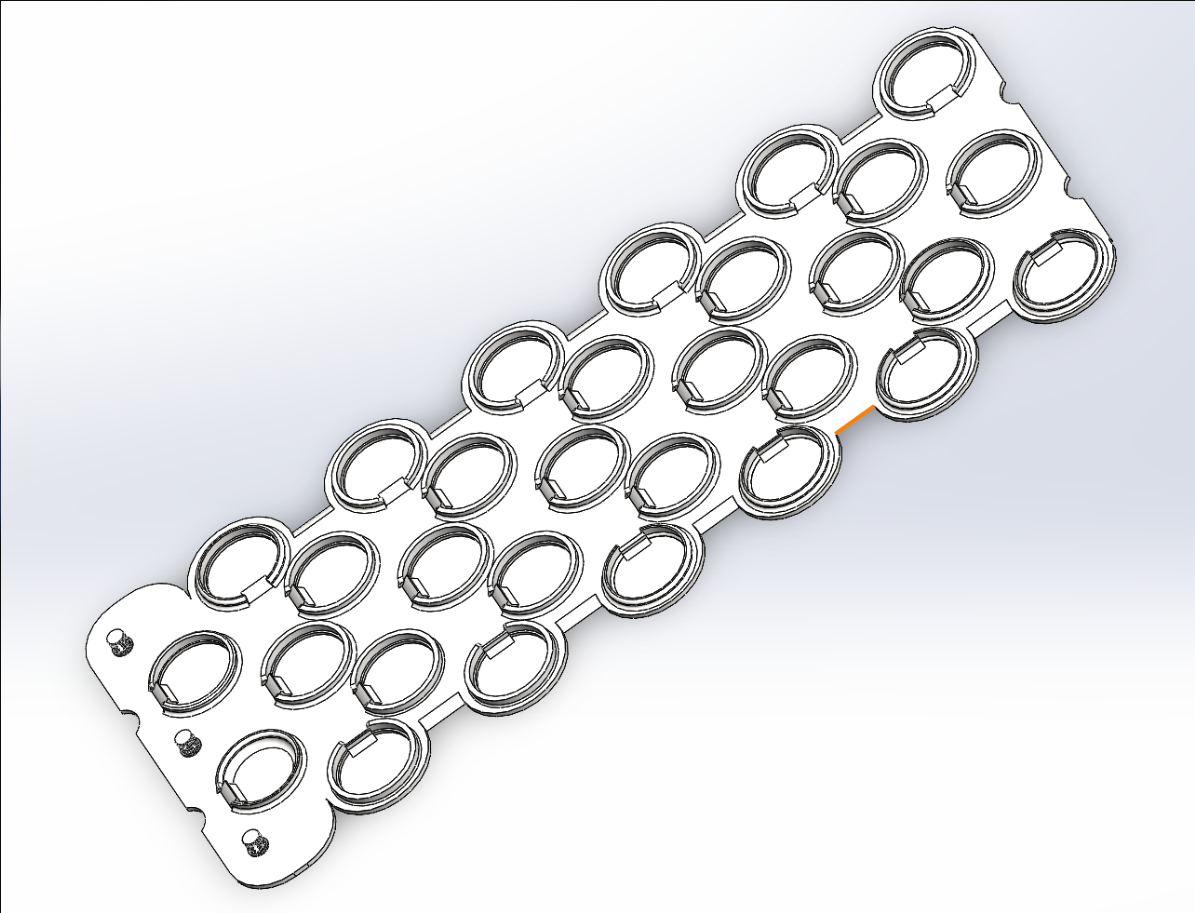
This was a team project exploring battery-pack manufacturing for the Lotus Evija. My contribution was the SolidWorks model: a repeated cell-connection layout and mounting outline for the busbar concept.
01 / THE PROBLEM
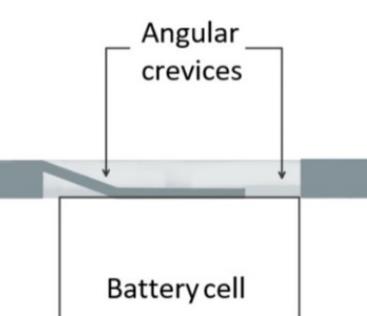
The team explored contamination and corrosion issues in copper busbar manufacture for the Lotus Evija battery pack. Angular crevices around cell connections can collect particles, which may affect weld quality and electrical performance.
02 / THE DESIGN MOVE
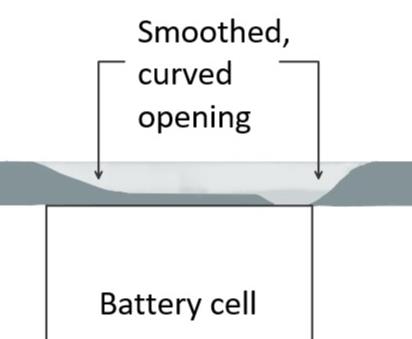
The team proposed a smoother, curved opening at the tab-cell interface to reduce sharp crevices. These cross-sections show the design intent; they are concept views, not test results.
TEAM DESIGN CONCEPT / CURRENT VS PROPOSED
03 / THE CAD
My contribution was the full repeated connection layout and mounting outline, modelled in SolidWorks. The complete view makes the spacing, repeated circular features and overall carrier shape easy to review alongside the proposed cross-section change.
The model is a concept for design discussion. It does not demonstrate electrical or thermal performance, prove contamination reduction, or represent a released manufacturing drawing.
04 / TEAM RECOMMENDATIONS
The team also considered material, corrosion protection and process improvements:
The team considered aluminium instead of copper. Its estimate showed a 46% mass reduction after increasing thickness by 56% to compensate for lower conductivity.
Retain nickel plating and investigate an added polymer electrostatic coating to improve corrosion protection on the busbar surfaces.
Improve inspection and cleaning controls, including non-destructive testing and more consistent rinse-water and tank hygiene.
Team project: the manufacturing research and recommendations were developed collectively. My individual contribution shown here is the SolidWorks CAD model. The proposed geometry and material changes would need manufacturing review and electrical, thermal, corrosion and contamination testing.